Showing posts with label Muses. Show all posts

Wednesday, October 21, 2026

From the Backlist: Bringing the Passion

 
As we move toward the end of the year, it's refreshing to look at the backlist and think about what came before. As this post from 2011 shows us, writer's are always looking for inspiration to bring more power, passion and riveting storytelling to their works. 

With that in mind, today's selection from the Backlist is Kim Falconer's writing tips on Bringing the Passion. Good for all seasons! 
 

We hope you enjoy!

*** 

Sunday, October 16, 2011 

Bringing the Passion

Write while the heat is in you. -- Henry David Thoreau

Passion translates through the pages and to make sure readers are enthralled, the writer must be too. But deadlines don’t go away when there is a lull, or the holidays have arrived, or there’s a new show on HBO. Writers must write, high, low, rain, sleet or perfect beach weather. Where does the inspiration come from? Here are a few ideas:

Tip #1 Show up: Writing is like a date; you have to show up if you want something to happen. Get to your desk every day, turn the computer on and say here we go! Sooner or later the Muse will be there, but you have to make the first move. Always.

Tip #2 Set an intention: State your goal for the day. Say it aloud. You might also write it down on a post-it and stick it to your monitor. It might be, two thousand words a day, flowing like a river, or ten pages edited, clean and easy. Setting an intention keeps the goal in sight. Adding a ‘feel good’ to the statement lifts the spirit.

Tip #3 Write what you love: This is major. If you aren’t passionate about your story, readers won’t be either. This isn’t something you can fake. Write what lights you up. If your current assignment doesn’t, find a way to change your mind about it. Throw caution to the wind. Fall head over heels. You have to LOVE the thing to make it sing!

See More of Kim's Books
Tip #4 Look after yourself: When others are on holidays, splashing in the pool or gliding down the ski slope, the ‘blank screen’ can seem like a punishment. When this happens, amp up the self-nurturing! Good food, power naps, exercise and socialise. Deadlines to not equate with prison sentences. You’ll get more done if you schedule in daily ‘me’ time.

Tip #5 Evoke the muse: In ancient times, no story told without calling on the Muses. ‘Tell me, O Muse,’ Homer begins, and we know where that got him. Stephen King suggests that when writers feel blocked it’s not because the Muse has abandoned them: I think what happens is that the writers themselves sow the edges of their clearing with poison bait to keep their muses away, often without knowing they are doing it. Love your Muse and she will love you back! More on evocations

Tip #6 Ghost write: If the keys aren’t clicking, open a new word .doc and write a few paras in another voice...

Read the complete article here: Bringing the Passion

***


Speculative Fiction (Fantasy/Thriller/Sci-Fi/Urban Fantasy) for adults and teens.


We're a group of best-selling authors providing news, reviews and interviews from the darker, more speculative side of fiction.


Fiction that makes the heart beat faster...


Friday, December 16, 2016

Writer's Agony and Ecstasy


Hi Everyone!

I shared a version of this earlier on AvaSykes.com and wanted to bring it here too.

The good news is, I've finished another novel!

The other news is, finishing it dropped me into a well of grief.

It's happened so regularly, this emotional plummet after achievement, a kind of post-completion depression, I decided to do a little research.

Turns out, it's a thing.

The ecstasy

It started out on Cloud 9. The first draft of a new work, a YA Paranormal, was complete, working title: The Cloud Forest. Here's the guff.
Fifteen-year-old Bri Arias survives a car accident but isn’t regaining consciousness. While her body lays comatose, her spirit roams the shaded world between waking and dreaming, life and death. In a parallel version, one where the accident never happened, Bri has the worst summer possible. Her archaeologist mother recruits Bri, and her year 10 Earth Science class, for a dig in the Andes Mountains. Touched by a shamanic spell, Bri becomes a ‘carrier’, a host to souls in transition, and most of them are not human. In one world, Bri is hospitalized and treated for schizophrenia; in another, she discovers a threat to the fabric of life-after-death. The only question is, can she wake up in time to save them both.
Christian Schloe

Then came the agony

They say the Hero's Journey is a metaphor for life. The stages, twelve or so  depending on who you read, correspond to the psychological steps taken every time we step out the door, start a project, job, relationship, degree, oil change, you name it. The process looks awesome on paper. A guide.

Encouragement.

Full Circle.

But it's not always that neat, especially at the end if the circle breaks and you spiral into the depths the 13th lost underworld.

Here's how it's supposed to go:

Step 12 - Return With The Elixir

"This is the final stage of the Hero's journey in which [the hero] returns home to the Ordinary World .... [They] will have grown as a person, learned many things, faced many terrible dangers and even death but now look forward to the start of a new life. - Dan Bronzite
Yeah, sure. Good, on paper.

But no.

Before any looking forward to new wonders of life, there is the part where you hit the pavement, face first.

The agony after the ecstasy of creative accomplishment.

You write the book, paint the picture, score the film, edit the video, choreograph the dance ... It took you a week, or a month, or two years. You give it your last tweak, mission accomplished and on comes the fanfare! Triumphant Muses! 

Ticker-tape parade!

So good on paper.

And maybe it happens like that, for some, but for me it's grief, utter and complete.

Back in the "real world," elixir in hand, and I want to curl up in some dark hollow and die.

Not so uncommon to feel that way

Sure enough, it happens to other writers.
The strangest thing about finishing a book is the incredible sense of loss -- and yes, a bit of depression - when it's over. - Jungle Red Writers on Post Book Depression

Evolutionary advantages

Apparently there's an evolutionary advantage to depression, and a plethora of scientific studies on the relationship between it and creative expression.
 ... the creative person, who spends his or her time ruminating on thoughts is likely to suffer from major depression. From an evolutionary standpoint, depression, while seemingly a hindrance to a healthy and happy life, is really a balancing act that helps us focus on the areas where we need to improve most. - Creative Something
If you look deeper at the hero's journey, it is actually there, in the "refusal to return."

Step 12b Refusal to Return

The full round, the norm of the mono-myth, requires that the hero shall now begin the labor of bringing the runes of wisdom, the Golden Fleece, or his sleeping princess, back into the kingdom of humanity, where the boon may redound to the renewing of the community, the nation, the planet or the ten thousand worlds. But the responsibility has been frequently refused. Even Gautama Buddha, after his triumph, doubted whether the message of realization could be communicated, and saints are reported to have died while in the supernal ecstasy. Numerous indeed are the heroes fabled to have taken up residence forever in the blessed isle of the un-aging Goddess of Immortal Being. -The Hero with a Thousand Faces, Joseph Campbell
For me, it's not so much a fall into darkness but divine homesickness, leaving the table of the gods behind. Leaving the world behind. It lasts a day or two, then slowly wears off, like a bad dream fading away.

Only then can I begin to think of the next step, the next work, and the process begins all over again.

How about you?

Has anyone else felt this way after a creative project is completed? A goal reached? I'd love to hear about it.

***

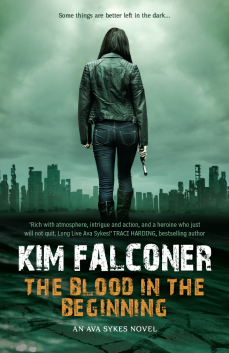
Kim Falconer's latest release is out now - The Blood in the Beginning - and Ava Sykes Novel. Find this novel in a store near you.

You can also learn more about Kim at AvaSykes.com, the 11th House Blog, and on FaceBook and Twitter and the new GoodVibeAstrology.com.

She posts here at the Supernatural Underground on the 16th of every month and runs Save the Day Writer's Community on Facebook. Check out her daily Astro-LOA Flash horoscopes on Facebook. 

Wednesday, September 16, 2015

Marinating Ideas


Loui Jover
Ideas hit hard and fast, right? A bolt out of the blue! A flash of insight! A stroke of genius!

Apparently, no.

Ideas do not come in a burst followed by the classical Eureka exclamation. They are not Athena, goddess of strategy, born fully grown, bursting from her father's head, wearing armor, shouting a war cry.

Research shows that ideas are a slow punch. They fade in after lingering in and around the corners of the mind.

Steve Johnson does a wonderful TED TALK on this. The upshot is, ideas marinate in a stimulating, chaotic soup. When we finally articulate them, they've actually been brewing for a substantial amount of time.

The myth of writers taking those long, solitary walks in nature, returning with the genius idea, or the philosopher sitting quietly by the fountain with chin resting on fist until realization bursts to life like a chorus of Kookaburras (listen to a chorus of Kookaburras here) is only partly true.

What really stimulates new ideas is coffee.

 Okay, not exactly coffee, but the coffee shop.

According to Johnson, the consumption of coffee coincided with the age of enlightenment, not so much for the stimulating properties, but because drinking more coffee meant drinking less alcohol. Let's face it, the water wasn't  exactly bacteria and parasite free. It was safer to drink beer, rum and wine day and night, which dulled the creative edge. Ideas definitely became sharper with the switch to a cup o' Joe.

Once out of the drunken stupor and into a kind of "writers room" environment with diverse and stimulating perspectives, ideas went wild, and they've been accelerating ever sense. The chaos and unpredictability of like and unlike minds, bantering in a free-for-all is much more conducive to flipping on the new neurons in the brain.
The Muses by Maarten van Heemskerck
Johnson says your office should look like a Maarten van Heemskerck rendition of Apollo and the Muses.
Think about it. Are the Muses - representing the manifestations of creative ideas - ever drawn in isolation, brows creased, nose in the books?

Most images I've seen are festival like dalliances that seem to go on day and night without end. There is definitely a lot of dancing and cavorting.

What this new research, and ancient wisdom, tells us about cultivating ideas can be summed up in four simple steps:

a) drink less alcohol

b) brainstorm with others

c) allow ideas to marinate and grow

d) nurture more connection; less protection

What I want to know is, where do your new ideas come from? Isolation or collaboration? A bit of both?
xxxKim

Kim Falconer is a Supernatural Underground author writing paranormal romance, urban fantasy, YA and epic science fantasy novels.

You can find out more about Kim at the 11th House Blog, and on FaceBook and Twitter.

She posts here at the Supernatural Underground on the 16th of every month.

Her latest release is "Blood and Water" in Supernatural Underground: Vampires Gone Wild.