Showing posts with label epicfantasy. Show all posts

Monday, March 2, 2026

A Year of Heroines #2 -- Yeine Darr and Rowan Birchmoon

 .
As mentioned last month, with completion of The Wall of Night (WALL) series I've been giving some thought to heroines in Fantasy -- all of which has prompted me to focus on them as m'theme for 2026!  Each month, I'll take a heroine (or two!) from a favorite book and contrast-and-compare with a 'leading lady' from the WALL series.


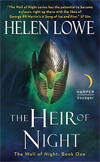
This month, I'm checking in on Yeine Darr from NK Jemisin's The Hundred Thousand Kingdoms, along with Rowan Birchmoon from WALL -- chiefly The Heir of Night, although her influence is felt throughout the series.

Yeine Darr and Rowan Birchmoon

Don't get me wrong, these are two very different characters with very different story arcs -- for starters, Yeine Darr is the main character in The Hundred Thousand Kingdoms, while Rowan Birchmoon is a "best supporting" player. 

Both, though, come from outlying lands (considered barbarian by some) but are forced by a mix of circumstance and choice to dwell among strangers who are, at best, reserved, and at worst, outright hostile. 

Kindle Edition

Yeine is her people's representative to Sky, the palace of the world-ruling Arameri (who are also her estranged kin), and although summoned there by her grandfather, she also seeks to resolve the murder of her exiled Arameri mother. Soon after her arrival, however, she is precipitated into a three-way contest to become the Arameri heir, which involves not only family and cultural politics, but a long-smoldering civil war between the gods -- quite a few of whom also reside in Sky.

Rowan Birchmoon is also an outsider, a woman of the Winter steppe residing in the alien Derai's Keep of Winds, on the bleak and inhospitable Wall of Night. In Rowan's case, it is love that has brought her there, as lover and consort (but not wife) to the Earl of Night. The Derai, however, dislike what they call "outsiders", and believe she must have bewitched the Earl into loving her, so Rowan's life is also fraught with danger. 

US edition

In The Hundred Thousand Kingdoms, the Arameri hold sway through magic, and both serve the gods that favor them, while binding others to their own service. Consequently, in Yeine's quest to survive the contest to become Arameri heir (and so the future ruler of the world, effectively) and uncover her mother's murder, she also becomes the central piece in a game of power between the gods -- a game that is soon complicated by romantic entanglement with Nahadoth, one of the most powerful and enigmatic of the gods that serve the Aramieri. 

The stakes in this latter game are even higher than the contest for the Arameri heirdom. In order to survive both, Yeine must discover the source of her own magic and use it to win a game of power that involves both heaven and earth.

Audio edition

On the surface, Rowan Birchmoon's path through The Heir of Night is a quieter one. She also differs from Yeine in knowing the core of her power from the outset. So although the Derai see her as their Earl's unwelcome consort first, and a huntress second, she is also a shaman of the Winter People, with the power to shape the seasons, and a seer. A hidden power, but one, along with love for the Earl of Night, that has brought her to the Wall -- and also to Malian, the prophesied champion (of February's post.) 

So when the chips are down, and Malian must flee for her life, Rowan Birchmoon will step into the game -- and what follows, at that point, will play as big a part as Yeine's in Sky, in shaping the course of her world.

UK edition


Prior Posts: A Year of Heroines 

~*~

About Helen Lowe

Helen Lowe is an award-winning novelist, poet, and lover of story. With four books published to date, she has recently completed the final instalment in The Wall Of Night series, which is now with its publisher,

Helen posts regularly on her “…on Anything, Really” blog, monthly on the Supernatural Underground, and tweets @helenl0we.


Tuesday, December 2, 2025

Great Leaders in Speculative Fiction #11: Faramir in "The Lord of the Rings"

.

"I do not love the bright sword for its sharpness, nor the arrow for its swiftness, nor the warrior for his glory. I love only that which they defend." ~ Faramir, The Lord of the Rings

Welp, here we are in December -- & ready to spend time with another of speculative fiction's great leaders. It's the last post of the year in this series, but by no means the least, because the character is Faramir, from JRR Tolkien's epic classic, The Lord of the Rings.

Faramir  in The Two Towers

Those who have read the books will almost certainly know why I want to shine the leadership spotlight on Faramir. I get, though, that those who have only seen the Lord of the Rings films may be a tad puzzled at this point. :-)

For those among you who fall into the latter category, I hope today's post illuminates not only why I think Faramir is a great leader, but why he's among my favorite characters in The Lord of the Rings books -- and why I was hugely disappointed by his treatment in the films. #JustSaying 

The Lord of the Rings

By way of background, in The Lord of the Rings the realm of Gondor and bastion city of Minas Tirith (the Tower of Guard), are largely standing alone against the growing might, and evil, of Sauron and Mordor. Faramir is the younger of the Steward (ruler) of Gondor's two sons, and he first appears in the latter half of the second book, The Two Towers. 

Minas Tirith

The ringbearer, Frodo, and his companion, Sam, encounter Faramir in a disputed borderland where they are waging guerilla warfare against the forces of Mordor. In the third book, The Return of the King, Faramir commands the final defense of Gondor's Osgiliath outpost, and fighting retreat to Minas Tirith.

Frodo & Sam on Mordor's border

Faramir has many outstanding leadership qualities, but the defining one is his moral center. When the one ring comes into his power Faramir repudiates it without hesitation, because he knows that its power, while immense, is also hugely corrosive and corrupting. And although deeply committed to Gondor, his loyalty is not blind. So despite knowing that his father, the Steward, would want exactly that, Faramir will not take the ring's corruption into the heart of Minas Tirith. 

Although a successful war-captain, who leads a series of successful forays against the enemy, Faramir is also merciful. So just as he will not take the ring from Frodo and Sam by force (as his brother Boromir attempted to do), he also refuses to slay them just because they are in the wrong place at the wrong time. Despite considerable misgiving, Faramir also spares Gollum at Frodo's request--which turns out to be a wise decision, and also a fortuitous one in the end, although his father and brother would both have dismissed such mercy as weakness. 

Nazgul attack

In the books, observers view Faramir as "stern and commanding", as well as "wise" and of "keen wit", so it's perhaps not surprising that his mercy demonstrates sound judgment. Yet however quiet his strength, Faramir shows considerable leadership chops--which is powerfully demonstrated when he holds Gondor's army to a fighting retreat from Osgiliath, rather than allowing his troops to give way to panic and rout. This is no small feat when not only facing vastly superior numbers but the supernatural evil and unrelenting attacks by the Nazgul ringwraiths, i.e. there is a very good reason they concentrate their attacks on Faramir.

Eowyn of Rohan

All reasons that it makes complete sense for the brave and beautiful Eowyn of Rohan to fall in love with him -- not as a 'consolation prize' because she can't have Aragorn, but because Faramir is the real deal. As both a man and a soldier he lights up the pages of The Two Towers and The Return of the King. Unquestionably, too, he deserves his place in the pantheon of speculative fiction's great leaders. 


Eowyn & Faramir: movie poster

~*~

Prior Posts: Great Leaders in Speculative Fiction ~ 
Where To Find 'Em & Why They Rock

February: Mara of the Acoma in the "Empire" series by Raymond E Feist & Janny Wurts

March:  Kaladin and Dalinar in "The Stormlight Archive" by Brandon Sanderson

April: Pyanfar Chanur in "The Pride of Chanur" series by CH Cherryh

May: John Aversin in Dragonsbane, by Barbara Hambly

June: Katniss Everdeen in "The Hunger Games" Trilogy by Suzanne Collins

July: Ulric of the Nadir in Legend by David Gemmell

August: Signe de Barbentain in A Song for Arbonne by Guy Gavriel Kay 

September: Dr Mensah in the "Murderbot" Series by Martha Wells

October: Katsa & Bitterblue in "The Graceling Realms" by Kristin Cashore

November: Coltaine in "Deadhouse Gates" by Steven Erikson
.

~*~


About Helen Lowe 

Helen Lowe is an award-winning novelist, poet, and lover of story. With four books published to date, she is currently completing the final instalment in The Wall Of Night series.
.
Helen posts regularly on her 
“…on Anything, Really” blog, monthly on the Supernatural Underground, and tweets @helenl0we.

Sunday, September 1, 2024

Secret Villains: The Year of the Villain in Fantasy #8

.
No discussion of villains in fantasy fiction would be complete without considering those "big bads" that work behind the scenes.

I can think of no better place to start than with the Black Ajah in Robert Jordan's Wheel Of Time fantasy series (completed by Brandon Sanderson and now adapted for television.) 

In Wheel of Time, Aes Sedai are an order of power users, all women, sworn to protect the world from the Dark One (the supreme "Big Bad") and divided into suborders or "ajahs", denoted by color. The Black Ajah are Aes Sedai secretly pledged to serve the Dark One rather than oppose it, who operate as a fifth column within the ranks of the other ajahs. 

Liandrin Sedai -- Black Ajah masquerading as Red...

Argued by many not to exist at all, finding and exposing them is a major part of the early work undertaken by three young adepts, Nyneave, Egwene, and Elayne, when they first join the Aes Sedai order. 

Egwene, Nyneave, Elayne -- hunting Black Ajah

The work they and others do end up revealing that the Black Ajah are numerous and operating at every level in the order. But secrecy and working from the shadows remains the Black Ajah's modus operandi throughout -- just as deception and betrayal, torture, murder, and insurrection, are their hallmarks.

Channeling the one power (saidar)

Among the ranks of fantasy's secret villains, I can think of few more compelling than Taravangian, in Brandon Sanderson's Stormlight Archive. Ostensibly an elderly and mildmannered king of limited intelligence, he has secretly dispatched an arch-assassin to murder his rivals, and exsanguinates patients in the charity hospitals he is publicly praised for founding. 

He also professes political support for Dalinar Kholin (one of the story's main protagonists), while all the time plotting to overthrow him. And although Taravangian does lift part of his veil of secrecy when necessity demands, he does so purely to survive and continue plotting and conniving another day.

Sometimes, the secret villain may present as a friend to the hero, in order to win their trust, learn their secrets, and ultimately betray them -- which is exactly what the young man called Flor does in my novel, Thornspell. Although there is a clearly recognized "big bad" for the hero to focus on, all the while Flor is at his side, smiling and winning his confidence...

Although when it comes to secret guises, my personal favorite is Deth in Patricia McKillip's The Riddlemaster of Hed series, who appears to be first one person, then another. His motivations and actions are one of the story's most constant and enduring riddles -- and he may not, in the final analysis, even be the betrayer and villain other characters think him. To find out for sure, though, you'll have to read the book and unravel its riddles, including that of Deth, for yourself. J

© Helen Lowe

~*~

About the Author

Helen Lowe is an award-winning novelist, poet, and lover of story. With four books published to date, she is currently completing the final instalment in The Wall Of Night series.
.
Helen posts regularly on her 
“…on Anything, Really” blog, monthly on the Supernatural Underground, and tweets @helenl0we.

~*~

Previous “Year of the Villain” Posts:

January:      Ushering in 2024 -- & the Year of the Villain

February:    The Year of the Villain #1: The Lord of The Rings Pantheon

March: The Year of the Villain #2: Ursula Le Guin & “Earthsea”

April: The Year of the Villain #3: Tigana and Brandin of Ygrath

May: The Year of the Villain #4: Elidor and Formless Evil 

June: The Year of the Villain #5: When the Hero Is Really A Villain

July:  The Year of the Villain #6: When the Author Messes With Your Mind

August: The Year of the Villain #7: The Evilest Of Them All