Showing posts with label Other writers. Show all posts

Sunday, March 3, 2019

High Fives from Amanda: Reasons to find your Peoples

This year has not really been any better than the trash fire that was 2018. I looked up and it was March.
MARCH. 

Like I missed the first two months of 2019 with my head still spinning, my desk still unorganized, and resolutions... forget it. I did manage to nearly finish a new book in the last two months, but its still unfinished, unlike that box of girl scout cookies I was supposed to share with my family. 

So I thought this year, 2019, we might just keep it short and sweet. As Helen is working through her Year of Romance, I'm going to work through a year of High Fives from Amanda, a short and sweet series of Top Five lists from yours truly. 

Five reasons you need to find a writing group. 
5. Writing has its own language. How many other hobbies really talk about the dark night of the soul on a regular basis? Other writers speak the language and you won't have to explain yourself to your significant other. Again. I've always thought people talking about football was like listening to the Droids from Star Wars, but some people get it. So its important to find your droids. 

4. Writing is a strange hobby. Other writers get it. They understand the carpal tunnel and the caffeine addition that you do to yourself willingly because you have this strange drive inside. Most importantly, they understand what happens when you don't write. When writer's block hits. They've hit the highs and the lows and they will have your back. They will laugh with you and cry with you and celebrate with you. 
Look at the #WritersCommunity hastag on Twitter.

3. Some will have already been there, gotten the tee-shirt, and its already in the cleaning rags pile. You don't have to reinvent the wheel, you just have to get it on your cart. When you find a group, sharing experiences and problems and resources becomes natural- you join a flow of information that you too can add to with your own experiences. 
"You're having a character problem- have you heard of this book?"  
"You're dialogue sequels aren't popping-- try this exercise." 
Mi shelf of writing books es tu shelf of writing books. 

2. Importantly, finding a group is a face-to-face, screaming reminder of hope that YOU ARE NOT ALONE. So many times growing up, I thought I would never find anyone like me, and when I did, I was so much more confident in all aspects of my life. This part of me wasn't wired wrong. There are other weirdly wired people too. 

MOST IMPORTANTLY, 

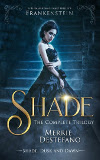
1. You might just get lucky enough to find a wonderfully supportive group like the ladies here at the Supernatural Underground blog who have literally been with be since the moment I launched my book and who continue to inspire me. I'm talking about you: Merrie and Terri and Helen and Kim. Stina and Rachel and T. Frohock too! 

Now most of these can also go for a sewing group, or a model rocket group, or a scuba diving group, but you need to find others who share your interests, your drives, your passions.  


If you have a Top Five list you'd like me to cultivate, please let me know in the comments below or at @pantherista. 

In the meantime, give yourself a high five!

Amanda Arista


Wednesday, November 1, 2017

The Magic & Wonder of Trees in Fantasy

.
"Enter these enchanted woods, you who dare..." 
- George Meredith, 1828-1909

Today I'm taking a look at the part trees play in Fantasy literature and whether authors in the genre have taken the Victorian poet's advice to heart. :)

Overall, it appears we have.

Ents, of course, are probably the most famous “trees”, or in their case, treelike beings, in Fantasy literature. They feature in the second and third books of The Lord of the Rings trilogy and played a major part in The Two Towers film, with the attack on, and destruction of Isengard:

“Pippin looked behind. The number of Ents had grown — or what was happening? Where the dim bare slopes that they had crossed should lie, he thought he saw groves of trees. But they were moving! Could it be that the trees of Fangorn were awake, and the forest was rising, marching over the hills to war? He rubbed his eyes wondering if sleep and shadow had deceived him; but the great grey shapes moved steadily onward.”
Sentient trees also feature in CS Lewis’s Narnia series and I’ve always loved the scene in Prince Caspian where Aslan reawakens the trees that have slept as a result of the Telmarine invasion:

“What Lucy and Susan saw was a dark something coming to them from almost every direction across the hills. It looked first like a black mist creeping on the ground, then like the stormy waves of a black sea rising higher and higher as it came on, and then, at last, like what it was — woods on the move. All the trees of the world appeared to be rushing towards Aslan.”
Sometimes, however, it is not a forest but a single tree that features — like the world tree in Mary Victoria’s Chronicles of the Tree series, which is first encountered in Tymon’s Flight:

“To starboard of the vessel…stretched a vast and furrowed mountain of bark, so wide that it’s curvature was almost invisible and so high that both its summit and its base were lost to view. The immensity of the wall was broken by a profusion of spoke-like limbs, the largest many miles in length. Several hundred feet above the dirigible the trunk culminated in the gently rising plateau of branches and twigs that made up the Central Canopy’s crown.”

Werewolves and other were-beasts have become very popular in recent years, but Fantasy contains at least one instance of tree-shifting: Danan Isig in Patricia McKillip’s The Riddlemaster of Hed, who teaches the skill to the protagonist, Morgon:

“Was I a tree? Sometimes I stand so long in the snow watching the trees wrapped in their private thoughts that I forget myself, become one of them. They are as old as I am, as old as Isig. . .”

When discussing trees in Fantasy I really can't go past the weirwood that stands at the heart of Winterfell, in George RR Martin’s A Game Of Thrones:

“At the center of the grove an ancient weirwood brooded over a small pool where the waters were black and cold. “The heart tree,” Ned called it. The weirwood’s bark was white as bone, its leaves dark red, like a thousand bloodstained hands. A face had been carved in the trunk of the great tree, its features long and melancholy, the deep-cut eyes red with dried sap and strangely watchful.”

And yep, trees do play a significant part in my own books, too.

Because Thornspell is a retelling of Sleeping Beauty — from the perspective of the prince who breaks the spell — the story needs must dives straight into George Meredith's "enchanted wood" territory:

“The road did not go far, petering out into a bridle path within a few hundred yards of the castle wall, and fading away altogether beneath the forest eave. It was very dark and quiet beneath the canopy, a heavy, listening silence. There was no call of bird or insect, no whisper of falling leaf—not even the wind stirred.”

Probably the most significant way in which trees shape the landscape in The Heir of Night (The Wall Of Night, Book One) is through their absence. The Wall of Night is a bleak, wind-blasted and lifeless environment and the contrast to more clement terrain only occurs in the last part of the book, when the protagonists cross into the hills of Jaransor:

“Eventually, Malian began to see the green shimmer of trees growing along small precipitous creeks, and they stopped at last in a narrow ravine where the trees formed a green roof and a stream ran clear over brown pebbles.”

In The Gathering of the Lost (The Wall Of Night, Book Two), trees and woods are a far more significant part of the worldscape:

“Mostly, Malian let the others talk as the miles fell behind them and Maraval forest rose up ahead like a green cloud … as the road took them deeper into the wood … the cavalcade fell silent, and the only sound was the clip of their horses’ hooves, the song of birds, and the deep susurration of the myriad leaves overhead.”

And still have their place in Daughter Of Blood (The Wall Of Night, Book Three):

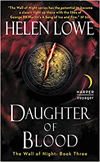
“Malian let her mind follow the secondary route, leaping over huddled villages with their sheep pens and rocky fields, to settle on a pine grove near the crest of the road’s first long ascent into the foothills. She had camped a night in the dry earthy hollow beneath the trees, which grew so close together that only the very heaviest rain fell between the branches. Now, it was the best shelter she could recall along the route’s wild terrain.”


So the arrows of evidence do seem to be pointing in the same direction: which is that trees play a significant part in Fantasy world-building, including my own work.

Mary Victoria's world tree - art (c) by Frank Victoria
I am pretty sure, too, that readers will encounter them again in The Chaos Gate (The Wall Of Night, Book Four), which is currently in progress.

How about you? Got any favorite trees in Fantasy literature to add to my list? All types of Fantasy welcome, from magic realism, through paranormal urban, to epic. :)

---


Helen Lowe is a novelist, poet, interviewer and blogger whose first novel, Thornspell (Knopf), was published to critical praise in 2008. Her second, The Heir of Night (The Wall Of Night Series, Book One) won the Gemmell Morningstar Award 2012. The sequel, The Gathering Of The Lost, was shortlisted for the Gemmell Legend Award in 2013. Daughter Of Blood, (The Wall Of Night, Book Three) is her most recent book and she is currently working on the fourth and final novel in The Wall Of Night series. Helen posts regularly on her “…on Anything, Really” blog and is also on Twitter: @helenl0we

Thursday, October 6, 2016

Guest Post: Of Sirens --- & The "Queens & Courtesans" Anthology

.
Today we are delighted to host Kristen Blount here on Supernatural Underground with a guest post on her involvement with the Sirens convention in the USA and the production and publication of the newly released Queens & Courtesans anthology.

***

Of Sirens --- & The "Queens & Courtesans" Anthology

A Guest Post by Kristen Blount


Despite reading almost exclusively in the speculative fiction genre, I am not much of a con-goer. In 2009, though, a favorite author (Sherwood Smith) mentioned that she was going to be a Guest of Honor at the brand-new Sirens Conference – along with Tamora Pierce and Kristin Cashore. Yummm. 

Being a responsible, part-time employed, full-time mom, I decided that I couldn't really afford a weekend in Colorado (being 2/3 across the country from home).

I received one of my best Christmas gifts ever that year… registration to Sirens!

The conference describes itself as being, “dedicated to the diverse, remarkable women of fantasy literature: readers, authors, scholars, librarians, educators, publishing professionals, and characters.”  Still, I did not really know what to expect and so was delighted to have a relaxing weekend in a mountain resort devoted to women in fantasy literature. 

The conference fostered conversations via roundtables, panel discussions, presented academic papers, and keynote presentations. It wasn't overly busy, with plenty of time built in for side conversations, walks, shopping at the book store, a visit to the spa, and impromptu meals with other attendees. I now look forward to seeing my “Sirens friends” every other year or so.

I don't know how to emphasize how different and lovely I found the experience of sharing a love of fantasy with other women (and the few men who joined us). It has been a revelation to meet all these other people who love girls with swords, the monstrous feminine, and even a little romance. These are just three of the themes that Sirens has considered – along with faerie, retold tales, and hauntings.

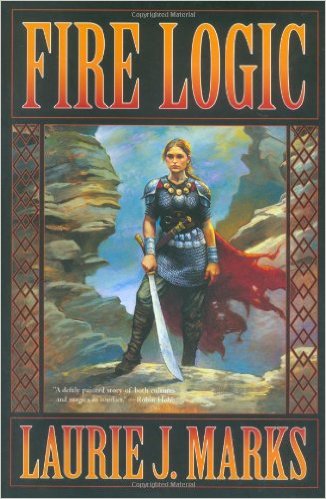
Finding new authors is always a bit of a struggle for me, since I am a shameless re-reader. This year, I discovered Renée Ahdieh's magical retelling of Shaharazad (The Wrath And The Dawn; The Rose And The Dagger) and Laurie Marks' Elemental Logic series.

I now can't wait to meet to the authors! Kiini Ibura Salaam's short story collection, Ancient, Ancient, is waiting for me to have a few more brain cells to devote to it. For some reason, short stories seem to demand more from me as a reader.
Speaking of short stories, something new and completely apropos arose among a group of Sirens attendees. We decided to produce an anthology! One of the writerly types talked on Facebook about having had a set of characters in her brain – a queen and a courtesan – who just would not leave her alone. This became a writing prompt, which quickly led to the proposed anthology to benefit our shared love of the Sirens Conference.

I happily signed on as a beta reader and editor. What a terrific experience it has been! Queens & Courtesans: A Sirens Benefit Anthology, edited by Jessica Corra, showed me a wide range of ways powerful women could interact.

In one of the stories I was lucky enough to proofread, all the characters are female: the ex-military space navigator/pilot, the nuns, and a bevy of school girls, one of whom is queen presumptive. Almost unbelievable, murderous plot twists aside, these women with different skills, agendas, and needs come together in frightening circumstances to work for a common good.

In another story I met a prince's lover, who was chosen by his mother because she's blind. This story is strictly told from the blind girl's point of view, and it brings a richness of other sensory details with it. Every story in this anthology gave me something to mull over in the days, or weeks, after reading.

If you have the opportunity, please consider purchasing a copy of Queens & Courtesans (available via Amazon and for most e-readers). It promotes the voices and concerns of women within the speculative fiction field. And mostly, it contributes to continuing the Sirens Conference.

If you have the opportunity, I also encourage you to consider joining us some year for a weekend of reading, talking about reading, and writing.

~ by Kristen Blount

---

Queens and Courtesans is published today. To find out more, click on:.

books2read.com/QueensCourtesans

http://www.goodreads.com/book/show/31936162-queens-courtesans

---
.


About Kristen Blount:

A lifelong reading enthusiast, Kristen enjoys speculative fiction most but will read just about anything that holds her attention and offers up a good story. With two adult-ish children who are nearing the end of school, Kristen has discovered the joys of free time to indulge in baseball, baking, and cross stitching. In order to pay the bills, she works in the local library’s marketing department as a graphic designer.

Saturday, October 1, 2016

Fashions In Names—Yes, Even in Fantasy Fiction

.
Have you ever noticed that there can be fashions in names for Fantasy characters, just as there are in real life?

Take “Ash” as in Aislinn/Aisling/Ashleen for example. It’s a real name, but in the mid-Noughts it ‘suddenly’ made a strong showing in Fantasy novels, particularly those with a YA flavour.

For example, Katie MacAllister’s Guardian series, published between 2004 – 2007, features protagonist Aisling Grey. In 2007, Ash — short for Aislinn — was the lead character in Melissa Marr’s Wicked Lovely, while in 2009 Malinda Lo’s Ash (a retelling of Cinderella) had another Aisling as the main character.

Almost simultaneously, Patricia McKillip brought out The Bell At Sealey Head (2008), which featured an Aislinn House as its (arguably) central location. Yet here’s where this gets really fun: one of the occupants of Aislinn House, and a main character in the book, was called Ysabo.

The previous year, 2007, Guy Gavriel Kay had published his standalone novel, Ysabel, with a main character of the same name — while Melina Marchetta’s first foray into Fantasy, the novel titled Finnikin of the Rock, had a main character called Isaboe. Noticing a trend, anyone?

Of course, all are variants of “Isabel” — so I must not omit Bella, short for Isabella, of the Twilight saga (2005 – 2008) fame.
Last but not least, I have to mention “Kat” — with Katsa in Kristin Cashore’s Graceling (2008), and Katniss in Suzanne Collins’ The Hunger Games (also 2008).

I’m sure there are many more you can point to — and I'd love for you to share them in the comments — but I thought these were sufficient to illustrate how there really can be fashions in Fantasy names at certain points in time, just as there are in everyday life.

---


Helen Lowe is a novelist, poet, interviewer and blogger whose first novel, Thornspell (Knopf), was published to critical praise in 2008. Her second, The Heir of Night (The Wall Of Night Series, Book One) won the Gemmell Morningstar Award 2012. The sequel, The Gathering Of The Lost, was shortlisted for the Gemmell Legend Award in 2013. Daughter Of Blood, (The Wall Of Night, Book Three) was published this year. 

Helen posts regularly on her “…on Anything, Really” blog and is also on Twitter: @helenl0we


 .

Thursday, September 1, 2016

Reads That Delight -- A Few Recent Highlights

.
Firstly, I'd like you to know that you have fellow Supernatural Undergrounder, Merrie Destefano, to thank for this post. "Hmm," I mused on Twitter, "today is my Supernatural Underground day. But what shall I post?"

"The best book you've read recently that surprised you, and why?" Merrie replied -- and the ideas were promptly flowing!

I couldn't think of a book that outright surprised me (because I am a pretty hard sell in that respect), but delight is a form of surprise, so I'm going to tell you what delighted me about some of my recent reads. Do feel free to chip in with some of your own "surprised" or "surprised by delights" in the comments, too. :)

And just so you know I'm not playing favorites, this list is in alphabetical order, yo! ;-)
.

The Parable of the Sower by Octavia Butler

Post apocalyptic, near future Science Fiction (Reading copy loaned by a friend.)

I love the main character of Lauren Olamina: her youth, determination, courage, cussedness, and devotion to her family and friends. I love that in the midst of surviving her post climate change world, Lauren is also founding her own religion, Earthseed. To find out all the ins and outs of that, though, you’ll have to read the book—I’m not even going to attempt to explain it to you beyond the central tenet: "God is Change."
.

 A Turn Of Light by Julie Czerneda

Fantasy (Reading copy supplied by the author.)

I was delighted by A Turn Of Light's historically informed worldbuilding, with the settlement of Marrowdell capturing a real flavor of pioneering Canada, complete to the technological realities of mills -- but also by the way the author weaves that together with a fantastical folklore that, while drawing on real-life sources, manages to be unique to the fantastic world of not only Marrowdell, but also the Verge...
.

The Blood In the Beginning by Kim Falconer*

Urban Fantasy (Reading copy supplied by the publisher.)

I believe I've made no secret about what I love most about The Blood In The Beginning -- it's the feisty, take-no-prisoners, and literally kickass heroine, Ava Sykes.

Ava has what we writers refer to as a great "voice", which instantly drew me in through her authenticity and realism. From the get-go, Ava and I connected, always a delight when you open up a new book.
.

The Los Nefilim Trilogy by Teresa Frohock*

Historical Urban Fantasy (Reading copy purchased.)

.
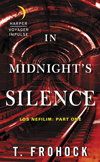
Urban, because this cycle of linked novellas is set in Barcelona; historical because it's the Barcelona of the immediately pre-Spanish Civil war period -- with angels and demons at war, and the nefilim as their foot soldiers. 

So if you like urban fantasy’s juxtaposition of the real and the supernatural, or the interweaving of real history with a parallel fantastic story, then I suspect you will share my delight in Los Nefilim.
.

Hild by Nicola Griffiths

Historical Fiction (Reading copy purchased.)

When I finished reading Hild, I decided just about everything about it is fabulous: a great historical sense of seventh century, Anglo-Saxon Britain, excellent characterization—especially of Hild herself; another awesome "voice."

But there’s a whole raft of other great characters, and just a wonderful richness of storytelling overall. 'nuff said?
.
.

Station Eleven by Emily St John Mandel

Post-apocalyptic, near future Science Fiction  (Reading copy supplied by the publisher.)

For me, Station Eleven was another exceptional read—but I loved most about the book was its exploration of a variety of different people, what makes us tick as human beings, and how we respond to life and circumstances (often very differently, obviously), at a range of different levels, from the personal to the societal.

I also really liked that this was, despite the post-apocalyptic premise, a hopeful book.
.

The Whitefire Crossing by Courtney Schafer

Epic Fantasy (Reading copy supplied by the author.)

I have just finished The Labyrinth of Flame, the third and final novel in The Shattered Sigil series -- but the reason I'm citing The Whitefire Crossing, the opening book in the trilogy, is because it encapsulates what delights me most about the series: this is adventurous fantasy par excellence, with the author's love of mountain climbing integral to the story.

If worldbuilding infused with American West landscapes, juxtaposed with a very well thought out magic system, appeals -- I rest my case.

Happy—book-reading—September!
.

* a fellow Supernatural Undergound author

---

Helen Lowe is a novelist, poet, interviewer and blogger whose first novel, Thornspell (Knopf), was published to critical praise in 2008. Her second, The Heir of Night (The Wall Of Night Series, Book One) won the Gemmell Morningstar Award 2012. The sequel, The Gathering Of The Lost, was shortlisted for the Gemmell Legend Award in 2013. Daughter Of Blood, (The Wall Of Night, Book Three) was published on January 26, 2016. 

Helen posts regularly on her “…on Anything, Really” blog and is also on Twitter: @helenl0we