Showing posts with label aspiring writers. Show all posts

Monday, July 22, 2024

From the Back-List - Explaining the Unreal

Cover art from the Song of Scarabaeus on Pinterest

Here at the Supernatural Underground, we are enjoying another awesome read from our back-list, posted Thursday, July 29, 2010 by the Philip K. Dick and Aurealis Award nominee, Sara Creasy. 

In this post, she talks about the difference between paranormal and SF. 

You can check out Sara Creasy's current work, The Wynter Wild Series on her Website. Join Wynter and her brothers on a heartrending and humorous journey through elementary particles, power chords, and the many meanings of love.

* * * 

Explaining the Unreal by Sara Creasy

Goodreads Choice Nominee
As writers and readers, how do we define the difference between the science fiction and paranormal genres? Both are “unreal” (in that they are fictional) and “speculative” (in that they extrapolate from existing ideas). The paranormal by definition breaks the laws of physics, but science fiction often does too (warp speed, anyone?).


I think the difference comes in what each genre needs to explain. For example, classic vampires can’t be exposed to sunlight without terrible consequences. Readers of paranormal fiction know this fact about vampires. If the writer chooses to contradict the convention by having her vampires run around the sunny beaches of Santa Barbara, readers expect a (paranormal) explanation: that old sunlight thing is a myth, the vampire has a magic ring, or this is a tribe of new improved vampires.

On the other hand, readers of science fiction base their expectations on the natural world. If a certain creature explodes into flames in sunlight, which contradicts what we know about the natural world, the writer needs to provide a (natural) explanation: the “vampire” has a medical condition such as a total lack of melanin, or, more exotically, the vamp’s unstable atoms are prone to decay when exposed to photons of a particular wavelength.

As readers we bring a stack of wonderful knowledge with us, drawn from mythology and the real world, saving the writer from having to describe and explain everything. But when a story contradicts that knowledge, often for interesting reasons of course, we want to know why...


To read the full post, including insightful comments, click here. 

To find out more about what Sara's doing now, visit her Website.


Monday, January 16, 2017

Mood Board Magic

New Moon by Pat Erickson
Hi everyone,

Today I wanted to turn on all you writers - aspiring or fully accomplished -  to the notion of Mood Boards.

If you have a visual sense, and most of us who can see do, creating mood boards can be one of the most inspiring practices you can do, that isn't actual reading or writing. Fabulous for tackling the 'blank page', starting a story 'in medias res' and giving your characters, animals, conflicts and geology the personality needed to come to life.

Want to create a mood board for your current project or seed of an idea?

Let's get started.

What is a Mood Board?

noun
  1. an arrangement of images, materials, pieces of text, etc. intended to evoke or project a particular style or concept.

    "We put together a mood board with key images and words that best convey the essence of the story, book cover, event our brand."
The Mood Board can be digital or physical. I used mostly digital mood boards for writing projects, and keep them, or just images on Pinterest, but more of that in a moment. Let's explore the uses next.


Uses for a Mood Board

  • To design a process, either abstract. as in writing, or tangible as in building in the physical world (books to covers to new kitchen designs).
  • The mood board is all about the vision. What you can't say in words.
  • Mood boards are essential when communicating visual ideas to others, as in commissioning a book cover, collaborating artistically or pitching ideas, including book to film projects.
  • A mood board is a springboard. Instead of facing a blank page, you can collect images as ideas for character, climate, topography, conflict and stakes in storytelling, or inspiration for a brand, or a brand new bathroom or garden.


How to Create a Mood Board

It's simple:

1. collect images

2. arrange the images in meaningful ways

This is all up to you and your individual style. The idea is to explore. Play around, and discover what lights you up the most.


Example Mood Boards

As I mentioned, mosts my book mood boards are on Pinterest for the world to see. It's a fun way to share images, get inspired and get to know your story world. Here is an example from a new series - just sold -  and soon to be announced. Working title - Amassia books 1-3.


If you are on Pinterest, I'd love to connect. And, shout out if you have an example of your mood board on line, or are just starting one. I'd love to see it. 
xxxk
Kim

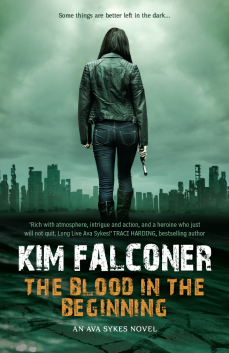
Kim Falconer's latest release is out now - The Blood in the Beginning - and Ava Sykes Novel. Find this novel in a store near you.

You can also learn more about Kim at AvaSykes.com, the 11th House Blog, and on FaceBook and Twitter.  

She posts here at the Supernatural Underground on the 16th of every month and runs Save the Day Writer's Community on Facebook. Check out her daily Astro-LOA Flash horoscopes on Facebook.