Showing posts with label Merrie Destefano. Show all posts

Tuesday, February 10, 2026

From The Backlist: "Why Do People Like to Read Scary Stories?" by Merrie Destefano

 .
It's that time -- and when it comes to backlist posts, this take on why we love a scary story is hard to beat.

It's penned by the fabulous Merrie Destefano, and we think you'll enjoy it every bit as much as we do. 

Why Do People Like to Read Scary Stories?

by Merrie Destefano

The sun goes down, the sounds of the city grow quiet, and the rest of the family nestles, safe and sound in a world of incandescent light. Meanwhile, one person huddles alone in a darkened room, face turned toward a screen, eerie blue light carving shadows on her face while her fingers slowly tap out a message, letter by letter.

A writer is writing.

October winds blow outside her window, leaves gather in shadowed corners of the yard and nearby trees sway, branches creaking.

The writer is writing a scary story.


Why do some writers always return to the dark side of literature, spinning out tales that make readers sit on the edge of their seat? Perhaps an even better question, and one that I’d like to discuss here, is why do some people love to read scary stories?

While, I can’t answer this question definitively, I can offer some suggestions.

1. ADRENALINE RUSH:
This is my favorite answer, although many of the others are just as good. We read scary stories so we can experience artificial situations of “fight or flight.” These scenarios, whether real or imagined, get your body ready for action by giving you an extra dose of adrenaline. Your heart beat speeds up, your breathing increases and your blood pressure increases—in other words, it’s like an instant dose of caffeine combined with heavy exercise. You’re ready to leap over tall buildings in a single bound, although you may be screaming “Mommy!” all the way.

2. FAMILIARITY:
You’ve been here before and you liked it. You’ve been reading scary stories for years, you have a list of favorite authors and you’re waiting in line, with sweaty palms, when his/her next book releases. You stay up late (reading these stories is always better at midnight, right?), turning pages while everyone else is asleep. But the truth of the matter is you can’t sleep, can you? Not until you know what happens next…

3. A VISCERAL REACTION:
The desire to feel something strongly—no matter what the emotion is—can drive readers to these books. Detailed descriptions of eviscerated body parts in zombie stories may not get you excited, but there are plenty of readers out there who live for this stuff.

4. TO FEEL ALIVE:
Similar to the answer above, books that put you on the edge remind you that you are alive. You’re not watching some soap opera at lunch time; you’re hunched over a novel wondering if the heroine is really strong and smart enough to survive that demon horde that’s been chasing her for the last twenty pages.

5. TO CONQUER THE DEMONS:
We all have our demons, things we’re afraid of but don’t want to admit. Things like clowns (It), menacing dolls (Chucky), the end of the world (The Stand), rampant pestilence (Contagion), rabid dogs (Cujo), vampires (Interview with a Vampire) and serial killers (Darkly Dreaming Dexter). By vicariously facing your fears in a novel, you’re able to tame them, or at least, imagine that you’ve tamed them. Until they show up the next night, waiting for you in the closet.

6. TO EXPLORE THE UNKNOWN:
There are boundless supernatural realms, where wonder and horror walk side by side—realms where people rise from the dead or where someone learns the future in their dreams or where someone is giving an extraordinary power. There’s just enough enchantment and mystery to make you want to know more, and just enough danger to make you glad this is fiction.

7. TO FEEL STRONG EMOTIONS:
Anger—hatred—fear—love—surprise—terror—repulsion—empathy…Scary stories have all these emotions and more trapped between the pages, just waiting for an innocent reader to come along and release them. Before you know it, you’re experiencing the same emotions. Again, this is similar to Number Three, but I felt that it needed to stated again. (It is my list, no?)

8. TO PROVE WE CAN SURVIVE:
Isn’t that what it’s all about? You’re secretly taking notes, so if X, Y or Z ever really happens, you’re ready. Doesn’t everyone know what to do in a zombie/alien apocalypse by now? And if so, why? Because you’ve all been making a list and checking it twice while watching The Walking Dead or Falling Skies.

9. SATISFACTION WHEN TERROR IS OVERCOME:
There’s an unbelievably sweet moment when the heroine finally plunges a stake through the heart of the last vampire—almost instantly, your muscles relax, you slump backward in your chair and then breathe a well-deserved long sigh because, without realizing it, you’ve been holding your breath and sitting on the edge of your seat, ready to run.

10. TO PROVE THAT DRAGONS NOT ONLY EXIST, BUT THAT THEY CAN BE DEFEATED:
What? Scary stories can give you hope? To quote someone more knowledgeable on this subject than me: “Fairy tales are more than true; not because they tell us that dragons exist, but because they tell us that dragons can be beaten.”― G.K. Chesterton. Watching a character deal with the monster in the closet can give you the courage to face up to your own monsters. Yes, tales of terror can actually be uplifting, when written with that purpose in mind.

To read the original post: click here 

To check in on Merrie, you can find her on her website and on Facebook 

Monday, October 13, 2025

From The Backlist: "Halloween Cometh" by Merrie Destefano

 .
We're into that month -- so we can think of no better way to herald Halloween than with a backlist post on that very topic. And from the wonderful Merrie Destefano, no less!

Enjoy!

Halloween Cometh

~ by Merrie Destefano

When I was a kid, Halloween was always my favorite holiday. Autumn came with brisk winds and falling leaves and carved pumpkins that lined everyone’s porches. Days grew shorter and shorter, as if soon it would be one continuous night. My neighborhood was filled with old, Victorian homes, tall houses with wrap-around porches and too many windows. It always seemed like some creepy person was watching me from behind the curtains, so that made trick-or-treating seem all the more dangerous.


For years, all of these elements stayed with me, through my teenage years and adulthood. Whenever Halloween approaches, my skin shivers and I expect something—insert sound of creaky old door opening here—unexpected, but slightly magical, to happen.

That was why I wrote FEAST: HARVEST OF DREAMS, and why I set it in a quiet mountain village, during Halloween. I wanted to share those emotions and expectations I had as a child. My main character, Ash—who is more than a little bit magical and possibly quite dangerous—even lives in a creepy, old Victorian house...


To read the original post, click here.

To check in on Merrie, who's written plenty more books since Feast, click on Merrie Destefano Home

Friday, May 16, 2025

The Art of Adaptation - Fantasy Monsters Part 1


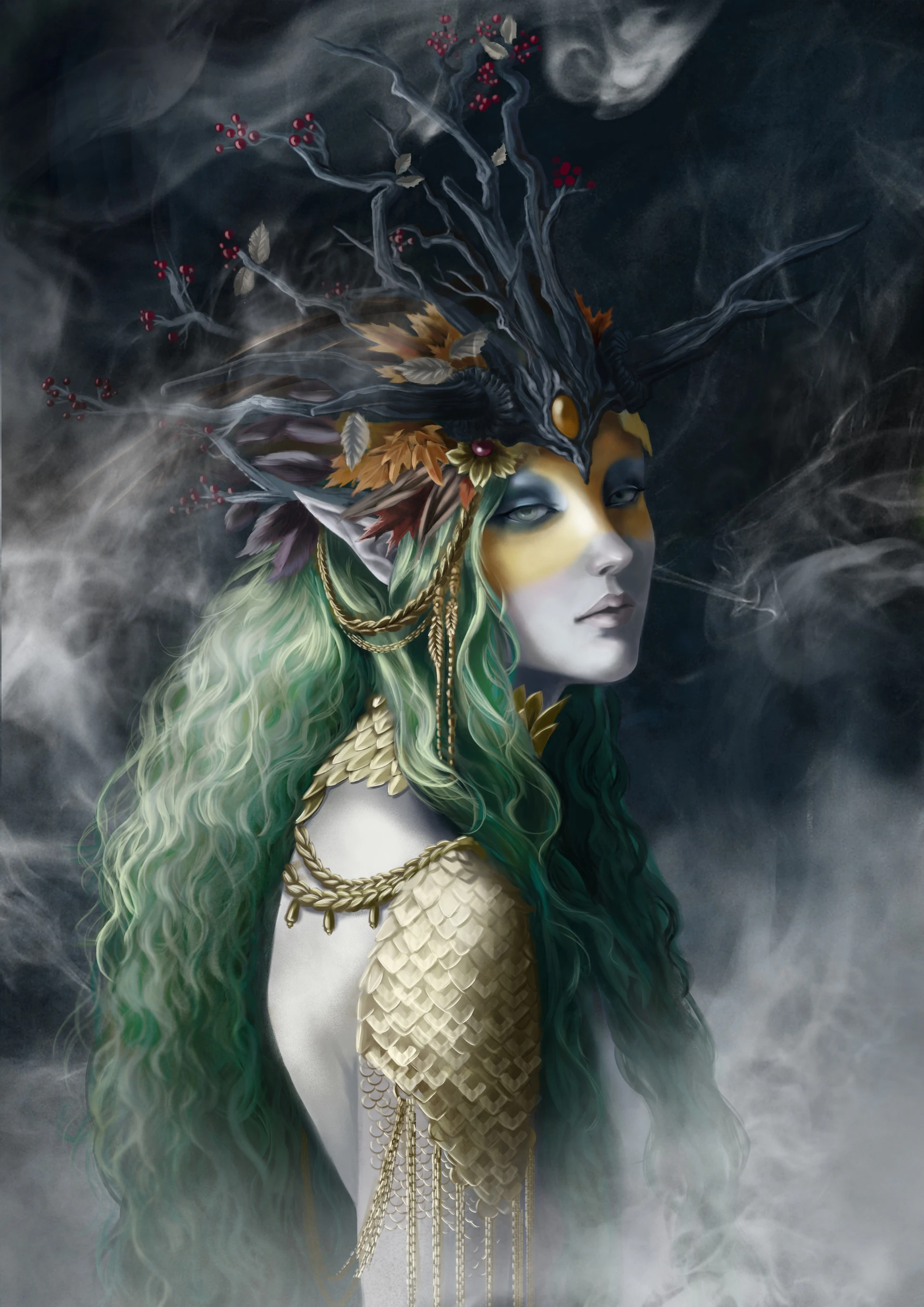
Theresa Konigseder Haller dark-fae-finalSee full size image


Hello Sup readers and writers,

Let me introduce you to today's topic in the Art of Adaptation series. It's all about Monsters!

In Fantasy Fiction, there are many kinds of 'evil' antagonistic creatures: classic monsters reimaged, new monsters with historical twists, and monsters from cultures beyond our familiar Western tropes. Through these creatures, we explore the physicality and psychology of our darkest nightmares and how they have adapted and changed over time. 

Classic Monsters


Mary Shelley's Frankenstein is often cited as the first published SF/horror story. Exploring themes of humanity, divinity, power and abuse, it has been frequently reimaged. the results are everything from the comedic Young Frankenstein film by Mel Brooks to Pádraig Kenny's middle-grade read, Stitch

One of our own Sup authors, Merrie Destefano, has written an entire series in this theme, starting with book #1, Shade.

A dangerous holiday. A deadly curse brought to life.

When Mary Wollstonecroft Godwin accepted an invitation to Lord Byron's house party deep in the Swiss Alps, she hoped it would serve as a welcome distraction from her broken heart. Instead, she finds herself surrounded by enigmatic guests with their own dangerous secrets to hide....

Another classic monster is seen in The Strange Case of Dr Jekyll and Mr Hyde, an 1886 Gothic horror novella by  Robert Louis Stevenson. It follows Gabriel John Utterson, a London-based legal practitioner who investigates a series of bizarre occurrences between his old friend, Dr. Henry Jekyll, and a murderous criminal named Edward Hyde. 

I think we are all familiar with at least one of the modern-day spinoffs, The Incredible Hulk. But this powerful monster has adapted to new motivations triggered by emotions. Through rage, he becomes incredibly powerful, but unlike the murdering Hyde, he often tries to help or protect others. 

Vampires Revissioned

The classic origin of vampires is usually cited as Bram Stoker's 1897 novel, Dracula. Here we see a hideous, ravenous monster, as portrayed in the film Nosferatu, but slowly, over time, a transformation in these creatures is occurring. The image of the vampire, still wicked and powerful, is now the alluring and attractive creatures of The Vampire Diaries and The Southern Vampire Mysteries

In more examples, four of our own Sup authors have contributed to the expanding genre with an anthology titled Supernatural Underground, Vampires Gone Wild! Have you read it?

A deeper dive into this relationship between readers, writers and vampires is HERE in The Evolution of the Vampire. One of the more intriguing aspects is ... not so much of the monsters themselves, but of our relationship to them. We don’t see evil like we used to! - From Vampire Evolution - 2011

The Fae and Other Forest Creatures

From Pixies to the Unseelie Court, books featuring Fae - revisioned or otherwise -  are extremely popular. Originally, we meet this brand of Fantasy creatures in the 1697 "Tales of Mother Goose," by Charles Perrault. It includes familiar stories like "Little Red Riding Hood," "Cinderella," and "Puss in Boots." 

Perrault's work was followed in 1812 by Grimms' Fairy Tales, which included stories like "Hansel and Gretel," "Rapunzel," and "Snow White". 

Many of these Fae from ancient folklore were dangerous, deadly so, but modern adaptations see them differently. Still risky and highly mercurial, contemporary Fae have something akin to a human heart. Consider Holly Blacks Folk of the Air, and Seanan McGuire's "Every Heart a Doorway.

Our own Helen Lowe began her Fantasy Fiction career with the publication of Thornspell - a reimaging of Sleeping Beauty from the point of view of the prince!

Further Shores - Dragons East and West

Chinese Dragon VS Western Dragon: Here's What You Need To Know

When dragons take the form of East or West, they split our cultural psychologies in half. They used to, anyway. Nowadays, you know when you are face to face with a Dragon, but you may not know what kind it is - one that brings the best day of your life, or the worst.

For example, Eastern dragons are benevolent, representing good luck and prosperity, a rain deity to be honoured, while Western dragons are commonly depicted as fire-breathing, treasure-hording, Smaug-like, destructive monsters that must be slayed. 

But contemporary storytelling in the West is changing as our dragons adapt to a more blended representation. Anne McCaffrey dedicated her life, intentionally or not, to this cause with her 25 volumes of Dragon Riders of Pern


Where to begin? Anne McCaffrey's first novel is Dragonflight 

In this world, dragons bond telepathically with a single human when they hatch, and then the pair spends their lives together protecting the planet from deadly Thread that falls from the sky. Those growing up with, or even reading her books for the first time, experience a new dragon psychology that is warmer, yet challenging, empowering, but full of risks. 


Compare this to the novels released in the last few decades featuring Eastern Dragons, such as Alison Goodman's Eon and Eona. Can you feel the adaptations, in both directions?


If you are drawn to a specific type of 'monster', I would love to hear about it! 

And, be sure to check back next month for part 2 in the Art of Adaptation - Fantasy Monsters

:) Kim

Other Posts in the Art of Adaptation 2025

January - The Art of Adaptation - Films in 2025

February - The Art of Adaptation - Authors' Response to External Pressures

March - The Art of Adaptation - The Healing Magic of KDrama

April - The Art of Adaptation -  Reader Persuasion

May - The Art of Adaptation - Fantasy Monsters Part 1

June - The Art of Adaptation - Fantasy Monsters Part 2 

July - The Art of Adaptation - Alternate History

August - The Art of Adaptation - AI: A New Chapter for Writers

September - The Art of Adaptation - Crafting Mood with Language

October - The Art of Adaptation - Take Five

November - The Art of Adaptation - On Time

***


About Kim Falconer 


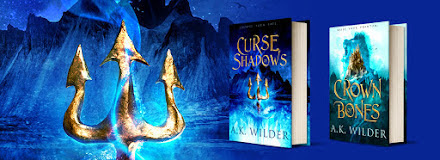
Kim Falconer, also writing as AK Wilder, has released Crown of Bones, a YA Epic Fantasy with Curse of Shadows as book 2 in the series. Currently, she is ready with the third book, out in 2025. TBA

Kim can be found on AKWilder.com, TwitterFacebookInstagram and KimFalconer.com

Throw the bones on the AKWilder.com site.. See you there!


Tuesday, March 25, 2025

From the Back-List: Confused about Genre?


Reading and Writing Different Types of Books
 

Today we share a back-list post from March 2013 from our very own Merrie Destefano, award-winning artist and author of multiple, intriguing genres.

Read the entire post Confused About What Genre You are Writing? and let us know what you think of these many subcategories of Speculative Fiction.

* * *

“What genre is this book?” 


This is a question that authors ask themselves frequently while writing. Agents ask it when considering representation. Editors ask it when acquiring. Marketing departments ask it while trying to promote the book. Bookstore staff members ask it when trying to categorize the book and when speaking to customers. Readers ask it before buying the book and when telling their friends about the book.

Phew.

The problem is, when you’re writing speculative fiction, all the boundaries seem to blur until you feel like you’re cross-eyed. To give you a brief example, when I wrote my first novel, Afterlife, I saw it as science fiction. When my editor acquired it, however, she asked for a few changes -- not many -- and the book was then marketed as an urban fantasy. To me, that book will always be sci-fi. But to many readers, it’s urban fantasy.

My current novel, Fathom, probably falls into the category of paranormal romance. But to me, it’s fantasy. I never saw the paranormal romance elements when I was writing the book. They’re probably there, but to me it was like a math equation:

Overarching coming of age theme + legendary creatures + mythological elements = FANTASY.

But then, I’m just the writer. Writers don’t usually get to decide what category their novels fall into. They just write the best book they can and try not to worry about things like markets or categories or the dreaded Latest Hot Topic.

So, just for fun, I put together a little Cheat Sheet for helping to define what category the book you’re currently reading might fall into. Now, these are just suggestions, not hard, fast rules. Here goes...

CATEGORIES OVERVIEW:

FANTASY: May take place in another world and often contains magic or supernatural elements. Does not contain scientific themes (otherwise, it would be science fiction.) Usually has a battle of good versus evil. May or may not have romance.
Books: The Lord of the Rings, Harry Potter, Game of Thrones.

HORROR: Can contains supernatural themes; meant to scare, startle or terrify. Sometimes rooted in folklore. May have vampires, werewolves, etc. Also may have a gothic tone. Sometimes written very beautifully, despite horrific subject matter.
Books: The Shining, Dracula, The Haunting.

PARANORMAL ROMANCE: May blend elements of science fiction, fantasy and horror. Takes place in our world, but often has otherworldly creatures, like vampires, ghosts, shape shifters, etc. A sub-category of fantasy and/or a sub-category of romance that contains experiences outside the normal or supernatural aspects.
Books: Highlander, Twilight, The Vampire Diaries. Read More...

* * *

We would love to hear about your favorite genres. Meet us in the comments!


Monday, February 10, 2025

From The Backlist: "Why Do People Like to Read Scary Stories?" by Merrie Destefano

 .
We love our Supernatural Underground backlist -- and it's very hard to go past this fun post from the fabulous Merrie Destefano!

Why Do People Like to Read Scary Stories?

by Merrie Destefano

The sun goes down, the sounds of the city grow quiet, and the rest of the family nestles, safe and sound in a world of incandescent light. Meanwhile, one person huddles alone in a darkened room, face turned toward a screen, eerie blue light carving shadows on her face while her fingers slowly tap out a message, letter by letter.

A writer is writing.

Wind blows outside her window, leaves gather in shadowed corners of the yard and nearby trees sway, branches creaking.

The writer is writing a scary story. 


Why do some writers always return to the dark side of literature, spinning out tales that make readers sit on the edge of their seat? Perhaps an even better question, and one that I’d like to discuss here, is why do some people love to read scary stories?

While, I can’t answer this question definitively, I can offer some suggestions.

1. ADRENALINE RUSH:
This is my favorite answer, although many of the others are just as good. We read scary stories so we can experience artificial situations of “fight or flight.” These scenarios, whether real or imagined, get your body ready for action by giving you an extra dose of adrenaline. Your heart beat speeds up, your breathing increases and your blood pressure increases—in other words, it’s like an instant dose of caffeine combined with heavy exercise. You’re ready to leap over tall buildings in a single bound, although you may be screaming “Mommy!” all the way.

2. FAMILIARITY:
You’ve been here before and you liked it. You’ve been reading scary stories for years, you have a list of favorite authors and you’re waiting in line, with sweaty palms, when his/her next book releases. You stay up late (reading these stories is always better at midnight, right?), turning pages while everyone else is asleep. But the truth of the matter is you can’t sleep, can you? Not until you know what happens next…

3. A VISCERAL REACTION:
The desire to feel something strongly—no matter what the emotion is—can drive readers to these books. Detailed descriptions of eviscerated body parts in zombie stories may not get you excited, but there are plenty of readers out there who live for this stuff.

4. TO FEEL ALIVE:
Similar to the answer above, books that put you on the edge remind you that you are alive. You’re not watching some soap opera at lunch time; you’re hunched over a novel wondering if the heroine is really strong and smart enough to survive that demon horde that’s been chasing her for the last twenty pages.

5. TO CONQUER THE DEMONS:
We all have our demons, things we’re afraid of but don’t want to admit. Things like clowns (It), menacing dolls (Chucky), the end of the world (The Stand), rampant pestilence (Contagion), rabid dogs (Cujo), vampires (Interview with a Vampire) and serial killers (Darkly Dreaming Dexter). By vicariously facing your fears in a novel, you’re able to tame them, or at least, imagine that you’ve tamed them. Until they show up the next night, waiting for you in the closet.


6. TO EXPLORE THE UNKNOWN:
There are boundless supernatural realms, where wonder and horror walk side by side—realms where people rise from the dead or where someone learns the future in their dreams or where someone is giving an extraordinary power. There’s just enough enchantment and mystery to make you want to know more, and just enough danger to make you glad this is fiction.

7. TO FEEL STRONG EMOTIONS:
Anger—hatred—fear—love—surprise—terror—repulsion—empathy…Scary stories have all these emotions and more trapped between the pages, just waiting for an innocent reader to come along and release them. Before you know it, you’re experiencing the same emotions. Again, this is similar to Number Three, but I felt that it needed to stated again. (It is my list, no?)

8. TO PROVE WE CAN SURVIVE:
Isn’t that what it’s all about? You’re secretly taking notes, so if X, Y or Z ever really happens, you’re ready. Doesn’t everyone know what to do in a zombie/alien apocalypse by now? And if so, why? Because you’ve all been making a list and checking it twice while watching The Walking Dead or Falling Skies.

9. SATISFACTION WHEN TERROR IS OVERCOME:
There’s an unbelievably sweet moment when the heroine finally plunges a stake through the heart of the last vampire—almost instantly, your muscles relax, you slump backward in your chair and then breathe a well-deserved long sigh because, without realizing it, you’ve been holding your breath and sitting on the edge of your seat, ready to run.

10. TO PROVE THAT DRAGONS NOT ONLY EXIST, BUT THAT THEY CAN BE DEFEATED:
What? Scary stories can give you hope? To quote someone more knowledgeable on this subject than me: “Fairy tales are more than true; not because they tell us that dragons exist, but because they tell us that dragons can be beaten.”― G.K. Chesterton. Watching a character deal with the monster in the closet can give you the courage to face up to your own monsters. Yes, tales of terror can actually be uplifting, when written with that purpose in mind.
...

Fun, huh?! To read the original post, click here.

To discover more about Merrie and her writing, go here.

Above all -- enjoy!

Saturday, February 10, 2024

From The Backlist: "What Happens When Writers Can't Sleep"

 .

Merrie Destefano
Today, we're excited to refeature another fabulous post from our Supernatural Underground backlist -- an intriguing insight into what happens when writers can't sleep, from the wonderful Merrie Destefano

Merrie shared this post in February 2011, but we think you'll enjoy revisiting it today, with a link through to the original for the full context, including comments.

So without further ado:

From The Backlist: What Happens When Writers Can't Sleep

by Merrie Destefano

Like most writers, I tend to over think things. Way too much. For the past several years, one of the things that has fascinated/terrified me is the whole process of falling asleep. I’ve analyzed and studied it to the point that sometimes I can’t go to sleep. (Insert silent scream here.) I will lay awake, trying to capture that moment when my waking self dissolves into my dreaming self, but it’s like trying to catch smoke in a bottle. And, as I already mentioned, one of the brutal side effects of all this is the fact that now I have trouble sleeping. 

Merrie's latest!

So what happens when a writer over thinks things? Especially if that writer can’t sleep?

She starts working on story ideas. About creatures who never sleep. Creatures who slip in your window in the middle of the night to steal your dreams.


.I mean, haven’t you ever wondered why you can only remember some of your dreams, while others you can’t remember at all?

All of my sleepless angst gave birth to my ... book—Feast: Harvest of Dreams—a tale of forbidden love and supernatural intrigue that mixes vampire and fairy lore to create a new paranormal creature. The book contains two interwoven love stories, one with the main character, a fantasy writer named Maddie, that will appeal to adults and one with a 16-year-old half-human/half-paranormal girl, named Elspeth, that will appeal to readers of YA ...


.
To read the full post and the comments, click here.

And to discover more about Merrie and her writing, visit her on: www.merriedestefano.com

Enjoy!

Thursday, March 16, 2023

Book Titles

Another in the More than meets the eye series...

Rabelais prĂ©sente Gargantua - Wikimedia Commons

Francois Rabelais, a 16th Century writer, cautioned against reading too much into a title. He said, [A book’s] title is usually received with mocking laughter and jokes. But it's wrong to be so superficial when you're weighing [a writer's] work in the balance.’ Good advice, especially nowadays when titles sell books. It pays to consider them carefully. 

But if that's true why are there so many weird titles? 

We can agree that the purpose of the title is to attract, intrigue and compel potential readers to pick up the book and buy it. It’s the headline, the very first sentence and it needs to hook the reader. That said, it can't be clickbait where the title has nothing to do with the story. Titles want to sound good—to roll off the tongue—but not be overly predictable or clichĂ©d. 

A good title can have double meanings, though it’s best to be careful there. For example, Mouse Work’s 1995 title, Cooking with Pooh is questionable. Catchy can work, like Big Boom’s If You Want Closure in Your Relationship, Start with Your Legs but that’s not quite the style speculative fiction readers are drawn to.


Other Considerations


 Now A Place of Magic

Titles have to fit on the book cover. I’m not sure how Crown got Charlatan: America's Most Dangerous Huckster, the Man Who Pursued Him, and the Age of Flimflam squeezed together with the author, Pope Brock, and a billygoat (I’m serious - check the image!) but they did. 

There are definitely rules to follow for selecting titles. Some writers ignore them, to their great success: 

Rule one—don’t use a proper name in the title. Like, um, Harry Potter

Rule two—don’t use words like Bane, Barbarian, Bard, Battle, Book, or Crystal. Like Jenifer Fallon’s bestselling Chaos Crystal

Rule three—don’t use adjective-noun titles. Like Sara Douglass’ bestselling Twisted Citadel

Rule four—don’t use needless complexity. Like, Do Androids Dream of Electric Sheep? As in, the bestselling SF by Philip K. Dick! I will admit that Blade Runner works better for the big screen.

Rules aside, there is a website where you can put your title to the test. This program generates the odds a title has of becoming a bestseller. If it’s accurate, my book #3 in the Amassia Series will sell a zillion copies! However the Da Vinci Code shows only a l4.6% chance of being a bestseller, so maybe take it with a grain of salt. 

The Working Title w/t

Working Titles (w/t) are often named organically, like pets. Book #1 of my Quantum Enchantment Series, The Spell of Rosette was just ‘Rosette’ for years. She got ‘The Spell’ as the story matured. Book #2, Arrows of Time was eventually named for the narrative structure, but for the first year of edits it was called The Winged Lion. A little bit like George Orwells book first called The Last Man in Europe. 1984 does have a better ring. More recently, Crown of Bones's w/t was Phantoms of Aku before that was nixed.

The bottom line is, no matter what you name your book as you write it, the publisher, you or marketing will likely give it another twist. For example, The Heart is a Lonely Hunter was firsts The Mute. Prometheus Unbound became Frankenstein. Catch 22 was first, wait for it, Catch 18. Treasure Island's w/t was The Sea Cook, and Gone with the Wind was Tomorrow is Another day

I asked my author friends to chime in on their title experiences and Merrie Defestano told me about one of her amazing novels. It's the one featuring Maddie MacFaddin (“Mad Mac” to fans of her bestselling magical stories). Maddie spent a blissful childhood summer in Ticonderoga Falls and that's where she wants to be when her adult life is falling apart... But is it really all so safe?

This title was first published by HarperVouyger as Feast - Harvest of Dreams, (see image above) but the latest edition is a revisioning of the story titled A Place of Magic released through Ruby Slipper Press. If you read the first paragraph, you will not be able to put it down. I promise!

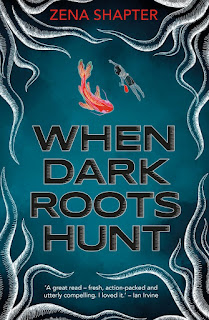
Another author friend, Zena Shapter, has a title coming out in May
called When Dark Roots Hunt, but that was not always the book's name. Originally it was called Ruin of Shade

When I asked her why the change she said, "I decided the title was too abstract for readers without first knowing the world. I also then changed some terminology in the book to make it more accessible for readers. In comparison, the title ‘When Dark Roots Hunt’ both evokes the book’s exotic ‘other’ world, and hints at the action and menace to come..."

I love it, and totally agree! It's a fantastic read you'll hear more about soon.

Does anyone have a good ‘title story’ to tell? Is there one that particularly compels or repulses?  Comments welcome!

xxKim

Posts in the 'More Than Meets the Eye' Series

Book Titles

The End

Backstory

Environment

Styling Characters

Desire

***

Kim Falconer, currently writing as A K Wilder, has released Crown of Bones, a YA Epic Fantasy with Curse of Shadows as book 2 in the series.

Kim can be found on  AKWilder TwitterFacebook and Instagram

Throw the bones, read your horoscopes or Raise Your Phantom on the AKWilder.com site